LETTERS
•
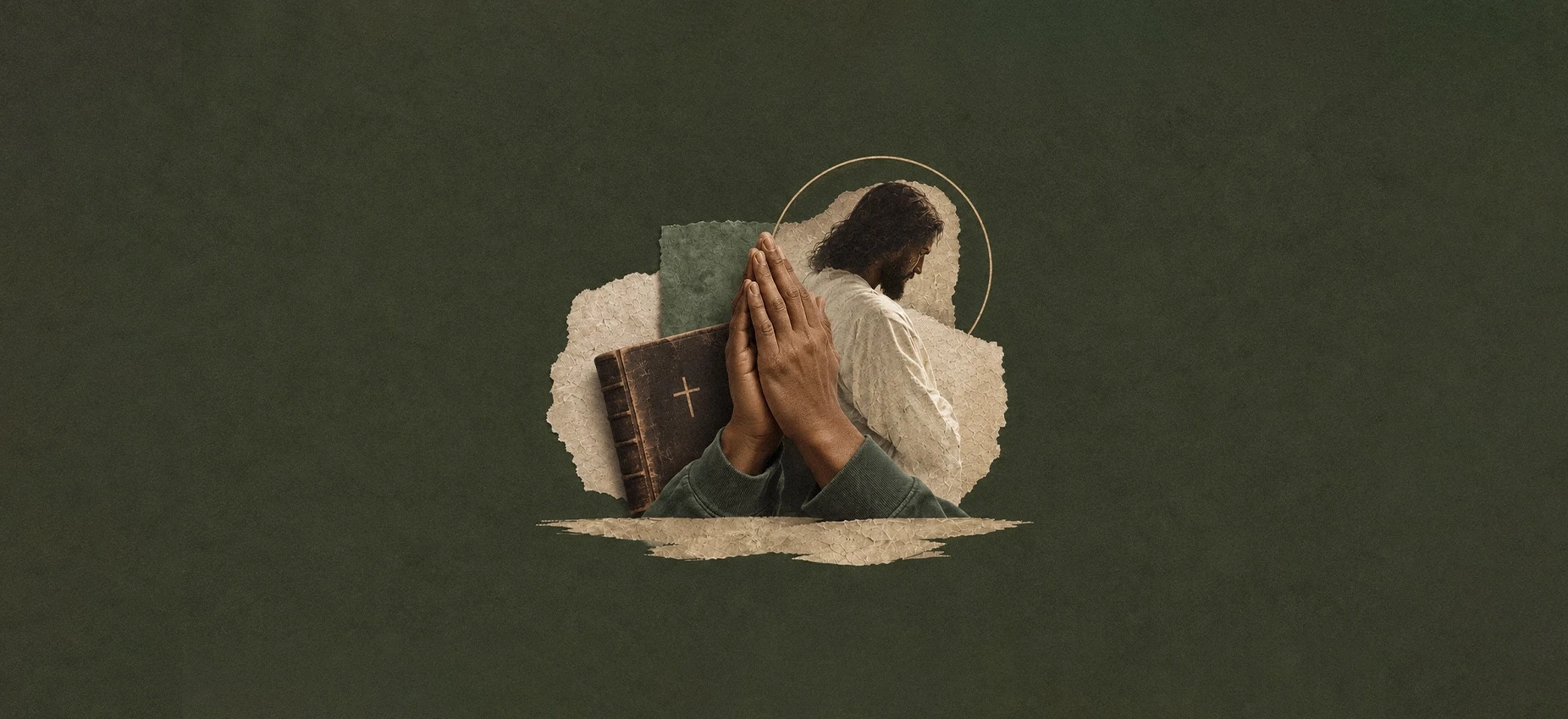
Why is it that what should be most natural to us as Christians is so often the most unnatural in practice? We were made to commune with God. We've been adopted as His children and given the Spirit, who cries out within us, "Abba! Father!" And yet, if we're honest, few things in the Christian life feel harder than simply sitting down to pray.
So why is it so hard?
That question plagued me for years. In my quest for answers, I memorized verses, read books, listened to sermons, and pursued just about every avenue for growth in this area. Well, everything but actually praying. Because, at the heart of it, I didn't really want to pray. That's a troubling thing for a pastor to admit, but I suspect many people feel the same and just don't want to say it.
It's not that I had anything against prayer in principle. I didn't want to pray because it required something I felt I didn't have: time. I live in Southern California, where life seems to move in the FasTrak (except on the 91), bouncing from place to place and commitment to commitment. When would I ever slow down long enough to pray? Maybe, more accurately, why slow down to spend time with God when there's so much I need to do for God? Again, I'm saying the quiet part out loud.
But time was never really the problem. My busyness revealed something deeper: I believed I could manage on my own. And I'm convinced that's why every fiber of our sinful flesh rages against prayer. It's the one practice of the Christian life that can't be done in self-reliance. We can read our Bibles out of discipline. We can serve out of duty. We can show up to church on autopilot. But real prayer requires us to stop pretending. It asks us to lay down our self-dependence, come before God exposed and honest, and admit that we need Him. And our flesh hates that.
But that's exactly what makes prayer so precious. We come to God because we need Him, and in coming, we find Him, which makes us desire Him more. The very admission our pride resists is the open door to communion. Every time we pray, we confess that we're not enough, and every time, the Father welcomes us in to be with Him.
So how do we grow? Not by trying harder in our own strength, which would miss the point of prayer altogether. We grow when we begin to see prayer the way Jesus did. The New Testament letters give us clear instructions: Paul calls us to "pray without ceasing" and to "devote yourselves to prayer," and John assures us we can pray with confidence. But these aren't abstract commands. Jesus lived them first. So we'll take the apostles' instructions as our guide and watch how Jesus embodied each one, discovering three pursuits that marked His life of prayer: consistent communion, deliberate dependence, and confident surrender.
1. Consistent Communion
Paul closes his first letter to the Thessalonians with a short, startling command: "Pray without ceasing" (1 Thessalonians 5:17). The word he uses describes something that keeps recurring without letting up. That's the picture of a life of constant communion: one that keeps returning to God, bringing praise, confession, requests, and thanks before His throne, again and again.
Jesus lived this way. He prayed at His baptism (Luke 3:21). He spent the whole night in prayer before choosing the Twelve (Luke 6:12). He prayed on the mountain of transfiguration (Luke 9:28–29), on the Mount of Olives before His betrayal (Luke 22:40–44), and even from the cross (Luke 23:46). Prayer wasn't an add-on to His ministry. It was the steady rhythm of a Son who loved being with His Father.
The disciples noticed. They had watched Jesus calm storms, heal the sick, and read the hearts of men. Yet the only thing they ever asked Him to teach them was this: "Lord, teach us to pray" (Luke 11:1). They knew what mattered most.
What I find most striking is how Jesus answered. "When you pray," He said, "say: 'Father, hallowed be Your name. Your kingdom come'" (Luke 11:2). Prayer doesn't begin with fear and trembling before a distant ruler. It begins the way a child comes to his father. God's people had long spoken of Him as the Father of Israel, but Jesus invited His followers to address Him personally, as their own Father, with an intimacy that would have startled many who heard it. When we come to prayer as children coming to their Father, prayer itself takes on new life.
So why do we pray so little? Often it's because we've forgotten what prayer is. We treat it as a duty to keep up rather than a door that has been thrown open. But prayer is the gift Jesus' blood secured for us: confident access into the very presence of our Father (Hebrews 10:19–22). We don't need to wait for a crisis to bring us to the end of ourselves. If we truly understood what's been opened to us, wouldn't we be quick to fall to our knees?
Take It to Prayer
Ask: Do I come to God like a dutiful servant, or like His child?
Apply: Choose three ordinary moments in your day, like waking up, your commute, or a meal, and let each one be a cue to talk to your Father. Start every prayer the way Jesus taught: "Father…"
2. Deliberate Dependence
Paul gives the Colossians a similar charge: "Devote yourselves to prayer, keeping alert in it with an attitude of thanksgiving" (Colossians 4:2). To be devoted is to keep at something because you're deeply attached to it. And "keeping alert" literally means stay awake.
I'll never forget an evening with a group of guys from church. We spent hours in the Word together, and it was one of the most encouraging nights I can remember. We closed with an extended time of prayer, and partway through, we heard the dreaded sound: snoring. One of the guys had slid all the way to the floor and fallen asleep. We laughed about it for a long time. But I understood the disciples in Gethsemane a little better after that. "The spirit is willing, but the flesh is weak" (Matthew 26:41).
Look at how Jesus handled His own weariness. Mark 1 describes an exhausting day: teaching in the synagogue, casting out demons, and healing a crowd that gathered at the door until well after sunset. Then Mark tells us, "In the early morning, while it was still dark, Jesus got up, left the house, and went away to a secluded place, and was praying there" (Mark 1:35). After a full day and a short night, Jesus got up before the sun to be alone with His Father.
Jesus' prayer was neither half-hearted nor a public performance. It was a personal, private priority. Luke says He "would often slip away to the wilderness and pray" (Luke 5:16).
So what do your disciplines say about your devotion? Most of us are disciplined people. We just tend to be disciplined about the things we love most. We'll get up for work, show up at the gym, and never forget a meal, yet struggle to give a few minutes to the One who cares for our souls. Paul reminds us that bodily discipline has some value, "but godliness is profitable for all things" (1 Timothy 4:8).
Take It to Prayer
Ask: What does my schedule reveal about what I think I can handle on my own?
Apply: Look at tomorrow's busiest stretch. Before it begins, slip away for five minutes and confess to your Father what you can't carry without Him. Busyness isn't your excuse to skip prayer; it's the clearest sign you need it.
3. Confident Surrender
John writes, "This is the confidence which we have before Him, that, if we ask anything according to His will, He hears us" (1 John 5:14). God isn't a cosmic vending machine. Our confidence doesn't come from getting what we want, but from praying in line with the will of a Father we trust.
We see that trust in Gethsemane. With the weight of the cross settling on Him, Jesus fell on His face and prayed, "My Father, if it is possible, let this cup pass from Me; yet not as I will, but as You will" (Matthew 26:39). Even in His darkest hour, He rested in the Father's character.
I see the need for that kind of trust often in the counseling office. I remember a young man, newly saved, fighting back tears because his wife had left him over his faith in Christ. He asked me, Why? Sometimes there's no tidy answer to that question. In those moments, the only anchor that holds is the character of God.
We also see confidence at Lazarus's tomb. Before calling His friend out of the grave, Jesus looked up and prayed, "Father, I thank You that You have heard Me. I knew that You always hear Me" (John 11:41–42). He gave thanks before the miracle happened, because He was certain of His Father's will.
People sometimes ask, "If God is sovereign, why pray?" That's exactly why we can pray with confidence. Our sovereign God invites us into His work and uses our prayers to accomplish His purposes. He doesn't need us to set Him in motion. On the contrary, He delights to let us take part.
Take It to Prayer
Ask: Where am I praying for my will, instead of trusting His?
Apply: Name the request or outcome you've been gripping. Bring it to God honestly, then pray as Jesus did: "Yet not as I will, but as You will." And thank Him in advance, as Jesus did at Lazarus's tomb, trusting that He hears you.
So your prayers matter. Need strength? He is the strength of His people (Psalm 28:8). Need wisdom? He "gives to all generously and without reproach" (James 1:5). Need grace? Come "with confidence to the throne of grace," and you will "receive mercy and find grace to help in time of need" (Hebrews 4:16).
That invitation changed my prayer life, and it can change yours. No more building walls where He has placed a door. Your Father is near, and He is listening. So, if you're looking for where to start, the same prayer the disciples prayed is a great place to begin:
Lord, teach us to pray.